
Analytical Instrument Design & Manufacturing
Analytical instrumentation engineering services that carry precision measurement hardware from first prototype through production.
Presco Engineering provides analytical instrument design services and manufacturing for scientific instrumentation companies, life sciences teams, and startups bringing a new measurement technique to market. Since 1978, we've built the electronics, firmware, optics, mechanical, and thermal systems behind spectrometers, DNA sequencers, immunoassay instruments, imaging systems, and other custom scientific instruments, including instruments that are still on the market today.
The biggest risks in an analytical instrument program tend to sit between disciplines: how the sensor meets the signal chain, how the electronics hold up inside the enclosure, and how a validated design moves into production. Presco keeps every one of those disciplines under one roof, so the engineers setting your noise floor are working right alongside the team packaging your instrument and the team that builds it, and far less gets lost at each handoff along the way.
Our manufacturing runs under an ISO 9001:2015 certified quality system, so every unit after the first is built to the same documented, repeatable process. And as the technology development partner behind more than $1 billion in combined startup exits, we know what it takes to get an instrument from a working prototype to a product customers buy. If you're building life science instruments, see how that work carries into biotech product development.
Schedule a Call
ISO 9001:2015
Third-party audited quality management on every manufacturing run.
NI Integration Partner
Recognized system integrator for NI test and measurement platforms.
$1B+ in Startup Exits
Technology development partner behind more than $1 billion in combined startup exits, including life sciences and scientific instrumentation.
Analytical Instrumentation Engineering Services for Precision Measurement
Built to measure right at the edge of the physics.
For most analytical instruments, the hardest number on the spec sheet is the noise floor. Presco's analytical instrumentation engineering services start there, designing the analog front end, high-speed data acquisition, and FPGA signal processing together so the signal your chemistry or optics produces arrives clean, fast, and repeatable. Whether you're building high-precision analytical instruments for research labs or for quality control on a production line, we've built signal chains down to a 1 microvolt noise floor and control loops precise to a fraction of a nanometer, and every instrument development program we take on gets that same discipline.
Precision Measurement Capabilities
Low-Noise Analog Front Ends
Sensor interfaces and low-noise amplifier design built from first-principles device physics, with noise floors measured in nanovolts per root hertz.
High-Speed Data Acquisition
Multi-channel ADC capture at hundreds of megasamples per second, with real-time compression and data handling for instruments that generate massive datasets.
FPGA Signal Processing
FFT processing, noise reduction, and parametric extraction running in hardware, backed by Presco's FPGA design services and our history as the first Xilinx Design Center in Connecticut.
Precision Motion and Control Loops
Control system design built on physics-based models, running in FPGA fabric for the mirrors, stages, and mechanisms that need sub-nanometer positioning.
Temperature Control
Temperature control loops that hold critical components to within 0.005°C, keeping thermal drift out of your measurement.
Calibration and Self-Test
Auto-calibration and built-in self-test designed into the electronics, keeping measurements accurate over the life of the instrument.
DNA Sequencer
A life sciences instrumentation client needed an analytical instrument that could read ultra-faint hydrogen ion signals off a custom sensor chip, the chemical signature of DNA sequencing, with a noise floor sitting right at the theoretical limit.
Presco delivered the complete data acquisition architecture, and its low-noise performance and speed to market were two of the factors behind the client's $750M acquisition shortly after launch.
The requirements left no margin:
- A 1GHz x 16-bit aggregate sample rate
- A long observation window that stressed 1/f noise on top of the usual thermal noise limits
- An aggressive timeline to market
Presco delivered a high-speed, low-noise data acquisition system:
- A 1 microvolt noise floor at 640 megasamples per second, 16-bit acquisition, reading millions of parallel chemistry experiments in real time
- Small FPGAs pulling data directly off the ADCs, with high-speed serial links into a central FPGA and DDR memory
- Custom lossless compression during each experiment's flush cycle
- An 18-layer board, from design to working prototype in about four months
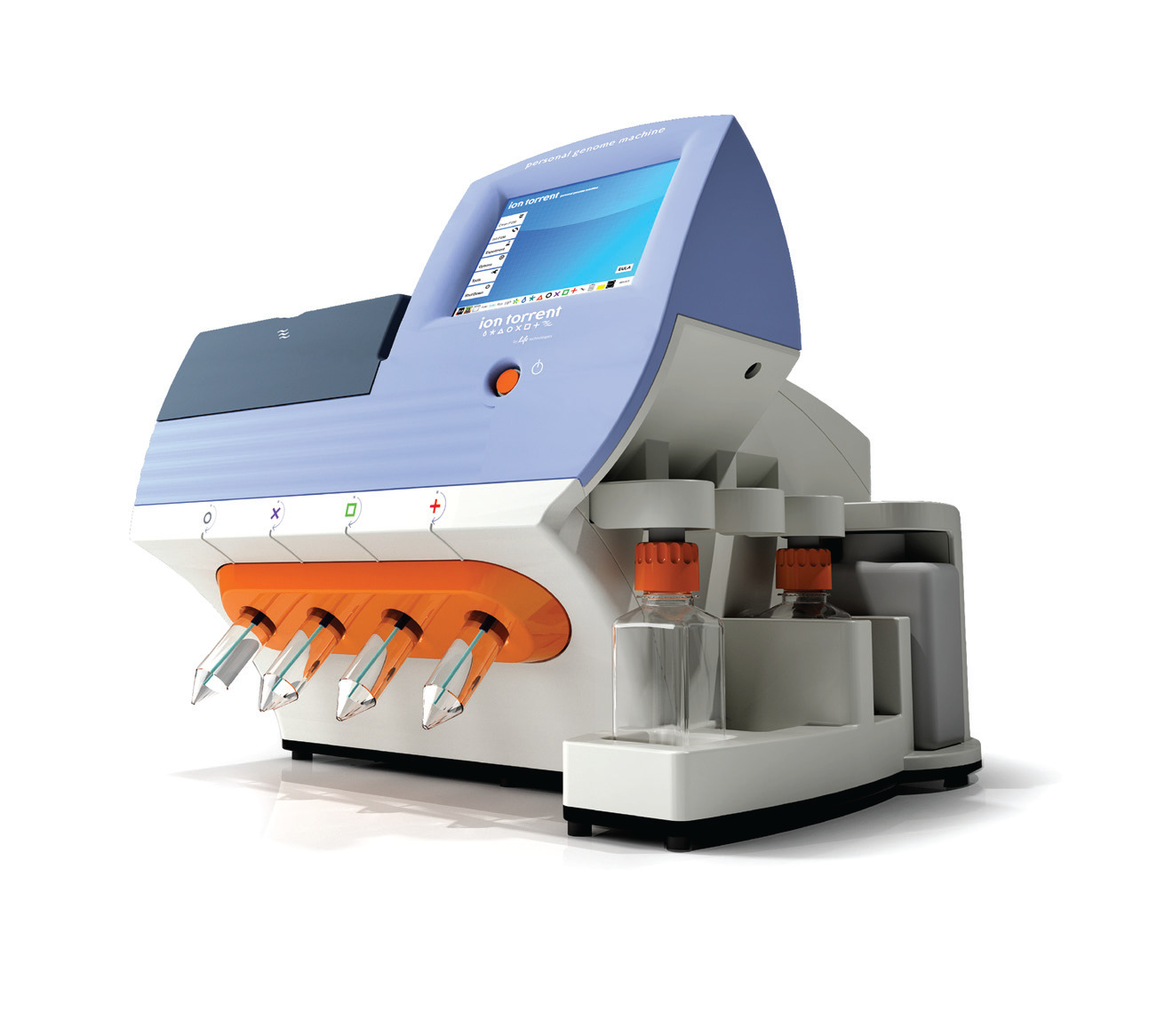
DNA sequencer instrument
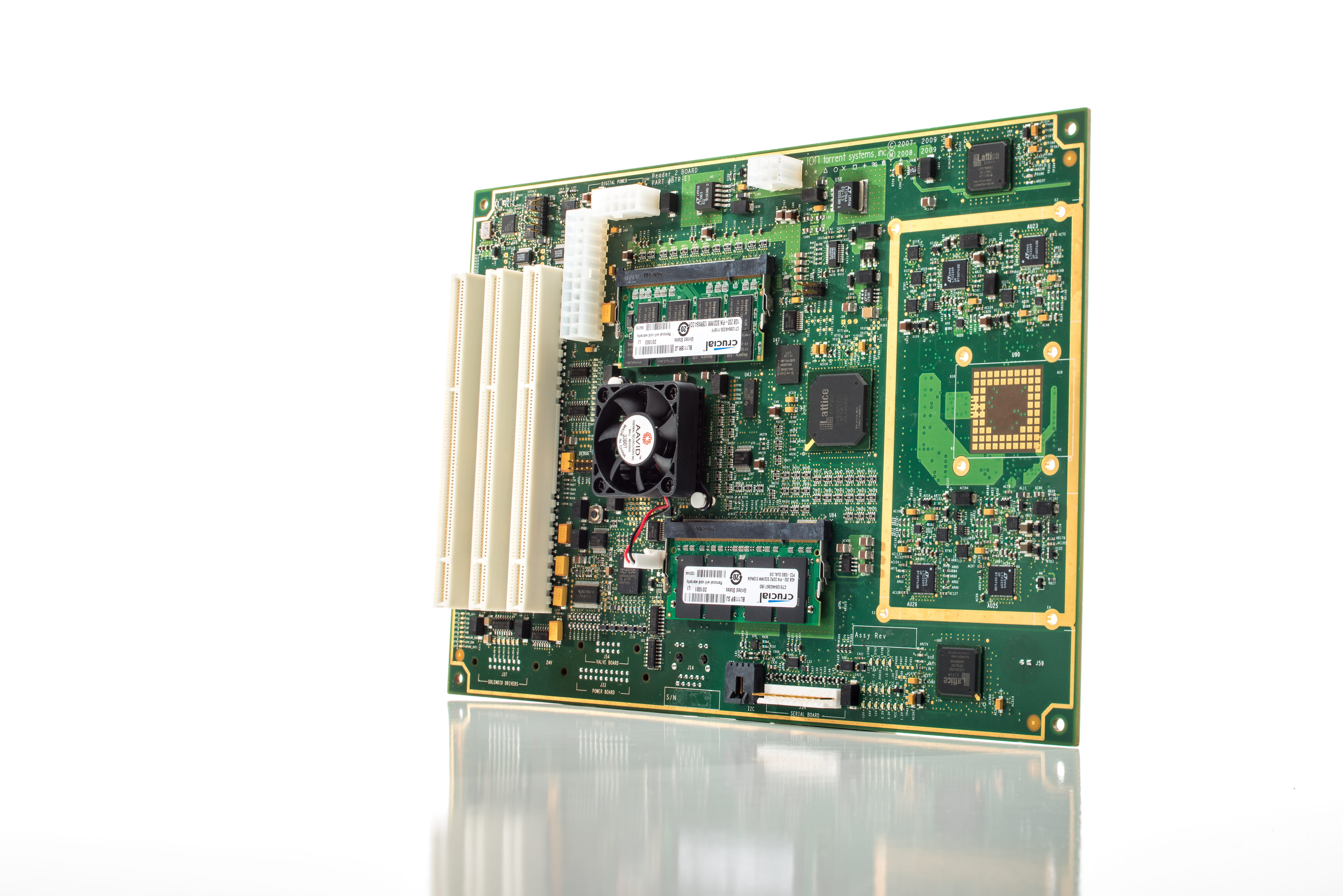
Data acquisition board
Portable and Field-Ready Analytical Instruments
Lab-grade results, wherever the sample is.
Taking an instrument out of the lab means fitting a benchtop measurement into a fraction of the space and power budget, while protecting a signal that's sensitive to every bump, tilt, and temperature swing. Presco handles analytical instrument design around those constraints from the start, partitioning electronics to use every cubic inch of the enclosure, managing battery power, and building control systems that keep the measurement steady when the world around it isn't. The result is portable analytical instruments that hold their accuracy on the production floor, at the field site, and in a technician's hand.
Portable Instrument Capabilities
Miniaturization and Board Partitioning
Electronics distributed across multiple custom boards to make use of all available space inside tight handheld enclosures.
Disturbance Rejection
Control loops that sense and correct for hand jitter, vibration, and tilt, so the reading holds steady in the field.
Battery and Power Management
Smart Battery System integration and low-power design for instruments that run untethered.
Embedded Processing and User Interface
System-on-module design, multiprocessor architectures, and color touchscreen interfaces that make a sophisticated instrument simple to operate.
Environmental Protection
Sealed, temperature-controlled, nitrogen-purged enclosures that keep optics clear and electronics in their working range in harsh conditions.
Field Firmware Updates
Presco's proprietary firmware update library, delivering reliable updates over CAN, I2C, Ethernet, Modbus, and Serial once instruments are deployed.

Analytical Instrument Manufacturing, From Prototype to Production
One team for every discipline your instrument touches.
Most instrument programs pass through several hands on the way to market, with one firm on the electronics, another on the enclosure, and a manufacturer at the end. Every handoff is a chance for design intent to get lost, and in a precision instrument, small things lost in translation can show up as performance that doesn't hold from the prototype to production units.
An analytical instrument is a system, and sensors, optics, electronics, firmware, mechanics, and thermal design all have to work together before a single measurement can be trusted. Presco brings electronic product design and development, software, mechanical, optical system design, and industrial design together on one program, working the architecture in parallel so integration problems get solved on the bench. That same team carries the design into our in-house manufacturing, handling low to medium volume production runs, so the engineers who designed your instrument are also the analytical instrument manufacturer building it.
Design and Manufacturing Capabilities
Design for Manufacturability
Designs refined for consistent assembly, test, and sourcing before the first production run, so production units perform like the prototype.
Optical and Electro-Optical Engineering
Optics, illumination, and detector integration designed alongside the electronics that read them.
Thermal Management
Finite element analysis and system-wide thermal control that protect sensitive optics and electronics.
Mechanical and Industrial Design
Enclosures, mounting, and serviceability designed around the people who actually operate and maintain the instrument.
Embedded Software and Firmware
Multi-processor messaging, real-time control, user interfaces, and instrument software developed in-house.
Manufacturing and Test
ISO 9001:2015 certified manufacturing for low to medium volume production runs, with in-house pre-qualification testing, plus trusted US-based contract manufacturing partners for higher volumes.
Benchtop to Handheld FTIR Spectrometer
A scientific instrumentation company needed the electronics for its benchtop FTIR spectrometer designed and built to production quality, and then set a bigger goal: put the same lab-grade measurement in someone's hand. That made this as much a spectrometer design challenge as a manufacturing one.
Presco carried both instruments from first prototype into production, as both the design team and the analytical instrument manufacturer, and the handheld is still on the market today.
The requirements left no margin:
- Production boards that matched prototype performance, unit after unit
- A full benchtop instrument shrunk into a handheld enclosure, with the mirror tracked to 0.3nm while ordinary hand jitter is enormous by comparison
- Measurement performance that held through miniaturization and into volume production
Presco delivered both instruments, from first prototype through production:
- Every benchtop circuit board designed and manufactured by Presco, hundreds built, with production carried through the client's acquisition
- A handheld redesign under 4 lbs, with electronics partitioned across 12 circuit boards and tilt compensation and hand-jitter correction for accurate readings at any angle
- A physics-based FPGA control loop tracking the moving mirror to 0.3nm, a Presco-designed preamp at a 2 nV/√Hz noise floor, and temperatures regulated to 0.005°C
- 2,500 handheld boards manufactured
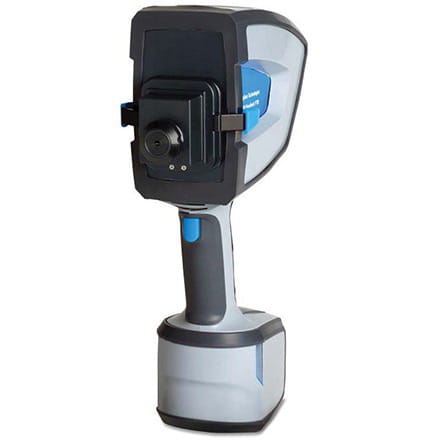
Handheld FTIR spectrometer
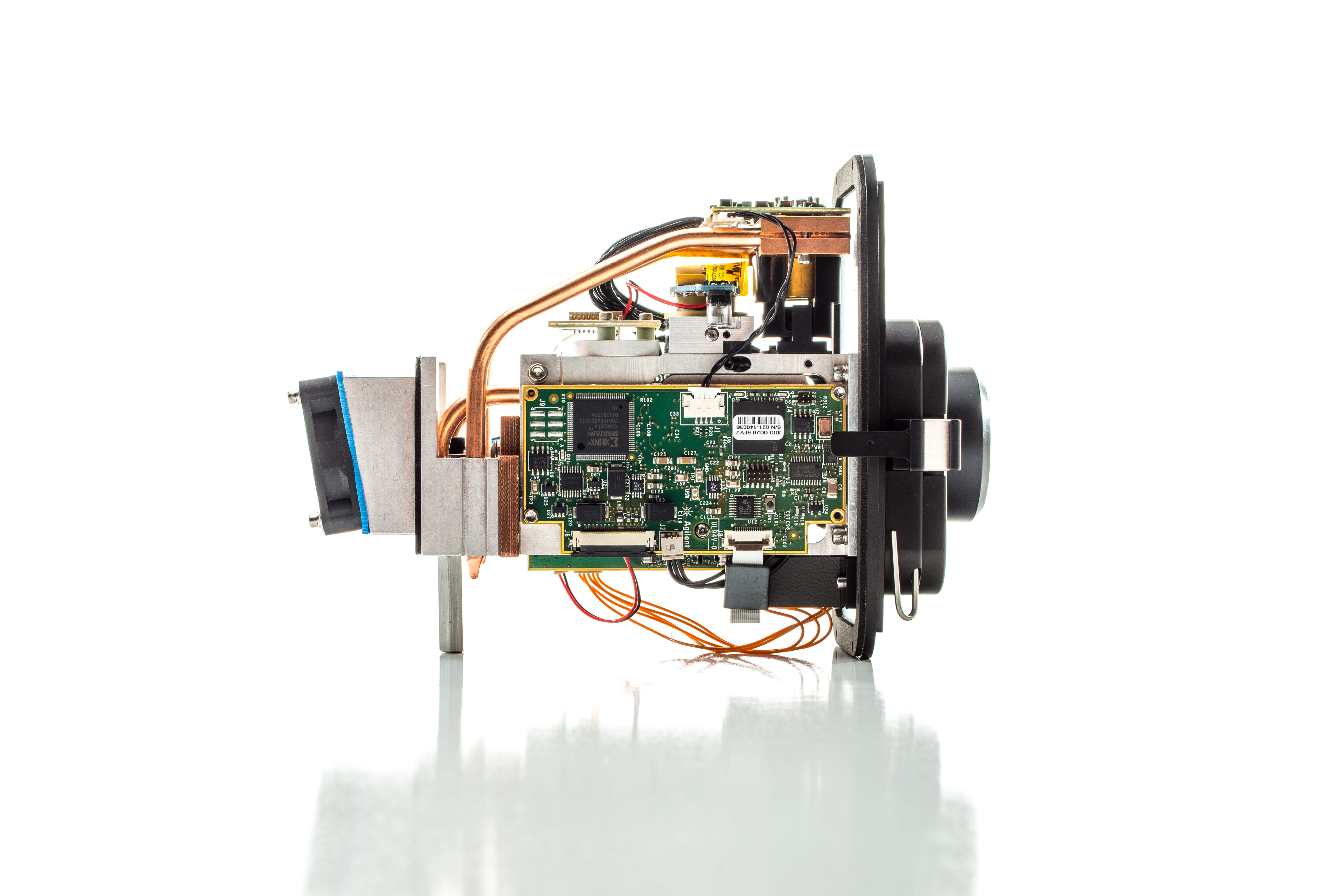
Multi-board electronics inside the handheld enclosure
From Design to Manufacture
Strategic Assessment
- Define the measurement up front: accuracy, noise floor, throughput, and operating environment
- Surface regulatory, cost, and supply chain constraints early, so they shape the architecture instead of surprising it
Architecture
- Electrical, optical, mechanical, thermal, and software engineers work the architecture in parallel
- Signal chain, packaging, and thermal tradeoffs get settled together, while they're still cheap to change
Development
- Electronics prototyping and board bring-up in-house
- FPGA designs regression-tested with Presco's proprietary testbench against emulated board hardware
- Firmware, calibration routines, and user interface developed alongside the hardware
Verification
- Instrument performance measured against spec: noise, accuracy, stability, and repeatability
- Environmental and thermal validation in-house or with certified lab partners, for the conditions your instrument will actually see
- Complete documentation and schematics delivered, so the design and the knowledge behind it are yours
Production
- In-house manufacturing with pre-qualification testing on every run
- Trusted US-based contract manufacturers for higher-volume programs, coordinated by the engineers who designed the instrument
- Field firmware update support once instruments are deployed
Start Your Analytical Instrument Program With Presco
If you're developing an analytical instrument, whether that's a new measurement technique that needs its first prototype, a benchtop instrument headed for the field, or a working design that needs a path to production, we'd like to hear about it. When you reach out, tell us what your instrument measures and where your program stands.
Tel: 203.397.8722
Analytical Instrument Design and Manufacturing FAQs
Q1What does a product development partner for analytical instruments do?
A product development partner for analytical instruments designs the hardware and software that turn a measurement technique into a working, manufacturable instrument: the sensor interface and signal chain, embedded firmware and FPGA processing, optics, mechanical packaging, and thermal management. Presco covers all of those disciplines under one roof and carries analytical instrument design into in-house manufacturing, so established instrument companies and startups alike can work with one team from first prototype through production.
Q2How do you turn a benchtop analytical instrument into a handheld or portable instrument?
It comes down to three problems solved together: space, power, and stability. The electronics usually have to be partitioned across several custom boards to fit the enclosure, the power system has to support battery operation, and the measurement has to be protected from hand movement, tilt, vibration, and temperature swings that a benchtop instrument never sees. On a handheld FTIR spectrometer, Presco solved the stability problem with a physics-based control loop in the FPGA that held a moving mirror to 0.3nm accuracy in the operator's hand.
Q3Should I use a design firm, a contract manufacturer, or a design-to-manufacture partner to develop an analytical instrument?
It depends on where your instrument is today. A contract manufacturer is a good fit when the design is finished, validated, and documented, and the job is building it at volume. An engineering design firm can take a concept through prototype, but the design then moves to a separate manufacturer who has to learn it from a document package. For most instruments still in development, a design-to-manufacture partner is the stronger option, because the engineers who set the noise floor, packaged the optics, and wrote the firmware stay involved as the instrument moves into production. Small decisions made during design, like a component choice or a calibration step, stay with the people who made them, and issues that come up on the production line get solved by the team that knows why the design works the way it does. Presco Engineering has worked this way since 1978, as both the design team and the analytical instrument manufacturer on instruments including spectrometers, DNA sequencers, and immunoassay instruments.
Q4Who owns the intellectual property when an engineering firm designs your analytical instrument?
You should. Presco doesn't take a stake in the IP of any product we help design or manufacture, and every engagement includes complete documentation and schematics, so you keep full ownership of both the instrument and the knowledge behind it.
Q5How do you take an analytical instrument from prototype to production?
A working prototype shows the measurement is possible, and production means every unit hits that same spec. Getting there usually takes four pieces of work. First, design for manufacturability, replacing hand-tuned parts and hard-to-source components so the instrument can be built consistently. Second, a complete documentation package, including schematics, assembly drawings, and test procedures. Third, calibration and test processes that verify accuracy, noise, and stability on every unit, often with custom test fixtures. Fourth, a pilot build that catches assembly and supply chain issues before volume production. Presco handles all four, then manufactures under an ISO 9001:2015 certified quality system with in-house pre-qualification testing before units ship, working with trusted US-based contract manufacturers for higher-volume programs.