
FPGA DESIGN SINCE THE 1980s
FPGA Design Services
Engineered right, an FPGA delivers precision and speed no other architecture can match. Engineered wrong, it's where schedules and reliability start to fail.
Since FPGAs first came out in the 1980s, Presco has been designing them for programs across markets and applications, built to mil-spec certification standards and precise enough to hold a handheld instrument steady to a fraction of a nanometer. Whether you're:
- A small team stretched too thin to take a design the rest of the way
- Integrating an FPGA into something bigger
- Already stuck on an intermittent problem that won't reproduce
Presco's FPGA services span first-principles architecture through production. That work is backed by a rapid product development team built to carry your product from concept to manufacturing, all under one roof.
Schedule a Call
Dedicated FPGA Team
Our dedicated FPGA design team including systems architects with 100+ years of experience is working hands-on with today's most advanced FPGA architectures
First Xilinx Design Center in Connecticut: four decades of tried-and-true FPGA expertise since the 1980s.
Presco is the technology development partner behind more than $1 billion in combined startup exits
ISO 9001:2015
ISO 9001:2015 certified manufacturing that ensures consistency from prototype to production.
Full-Lifecycle FPGA Services
Presco's FPGA design services cover the full lifecycle of a digital design: requirements and architecture, RTL development, verification, prototyping, and field-ready validation. FPGA systems engineers work directly alongside our product development team, so the FPGA is designed as part of the product, not as an isolated black box handed off between vendors.
Presco's FPGA services cover every stage of a program, from a complete design built from the ground up, to surge support for a program already underway, to the prototyping and validation that proves a design out. Here's what that looks like in practice:
FPGA Architecture & Digital Design
First-principles requirements through a validated architecture:
- Component and technology selection
- Risk assessment
- Detailed digital design in VHDL
From low-level bus infrastructure to complete signal chains at multi-giga sample rates.
High-Speed Data Acquisition & Signal Processing
Capturing and processing signals at the edge of what's physically possible:
- Multi-GSPS (gigasamples per second) ADC/DAC interfacing
- FFT processing
- Noise reduction
- Parametric extraction
Often within microvolt-level noise floors.
Control Systems on FPGA
Custom control loops implemented directly in FPGA fabric, from enhanced custom PIDs to physics-based control models built on first-principles mechanical or thermal equations.
FPGA Prototyping & Validation
Every FPGA design is simulated alongside models of every component on its circuit board through Presco's proprietary testbench methodology, so it reaches you already proven to integrate.
FPGA Engineering Surge Support
When an in-house team has the expertise but not the hands to hit a program deadline, we plug in, bringing the additional engineering capacity a defined program needs, without the overhead of a full-time hire.
Neural Networks on FPGA
When a general-purpose processor is too slow, FPGA-based neural network implementations for real-time signal and image processing, used on projects like real-time OCR and object tracking.
The Presco Testbench
By the time a design reaches you, it has already been proven in a full simulation of the board it will operate on, every component included.
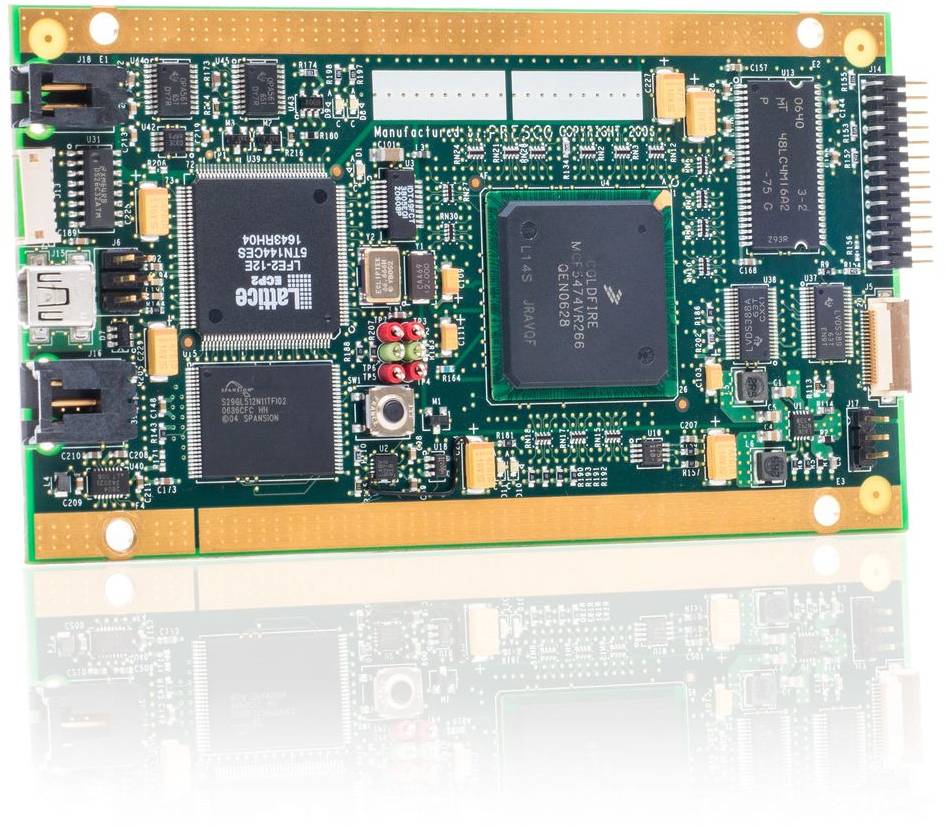
Every FPGA design is only as reliable as its validation process. Over four decades of FPGA development, Presco built a proprietary testbench that recreates the entire circuit board environment around the FPGA, not just the FPGA itself.
A sequence controller runs one or many test cases against the design, exercising the full feature set of the FPGA under realistic conditions. The same framework supports regression testing throughout development.
Emulated ADC
Stands in for the analog-to-digital converter the FPGA will actually talk to in the field.
Emulated DAC
Stands in for the digital-to-analog converter the FPGA will actually talk to in the field.
Emulated DDR Memory
Stands in for the memory the FPGA will actually read from and write to.
SPI / I2C Peripherals
Stands in for the peripherals the FPGA will actually talk to over the bus.
Processor Emulator
Standing in for the processor the FPGA will operate alongside in the field.
FPGA Under Test
Runs inside that full simulated environment — not in isolation — so every real-world connection is proven before deployment.
Sequence Controller
Runs one or many test cases, using C-like test case coding to perform bus reads and writes.

FPGA board developed from Presco's testbench.
FPGA Programs Presco Has Delivered
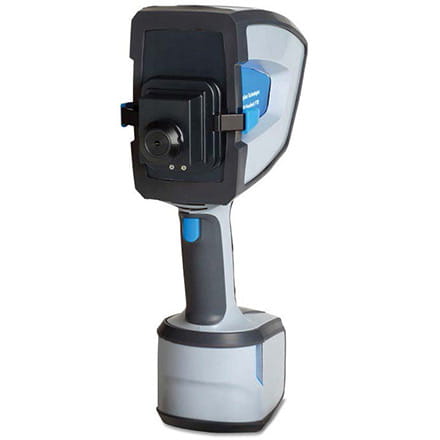
Handheld FTIR Spectrometer
A client needed a scientific instrument small enough to carry into the field, with the nanometer-level precision of a lab-grade spectrometer. Precise enough to:
- Identify an unknown substance on the spot
- Catch a stress fracture in an airplane wing after a storm, by reading disruptions in the metal's crystal lattice
The requirements left no margin:
- Track a moving mirror's position to 0.3nm accuracy, in real time
- Reject ordinary hand jitter that would otherwise swamp a signal that precise
- Hold a detector at −50°C, stable to 0.005°C, inside a handheld enclosure
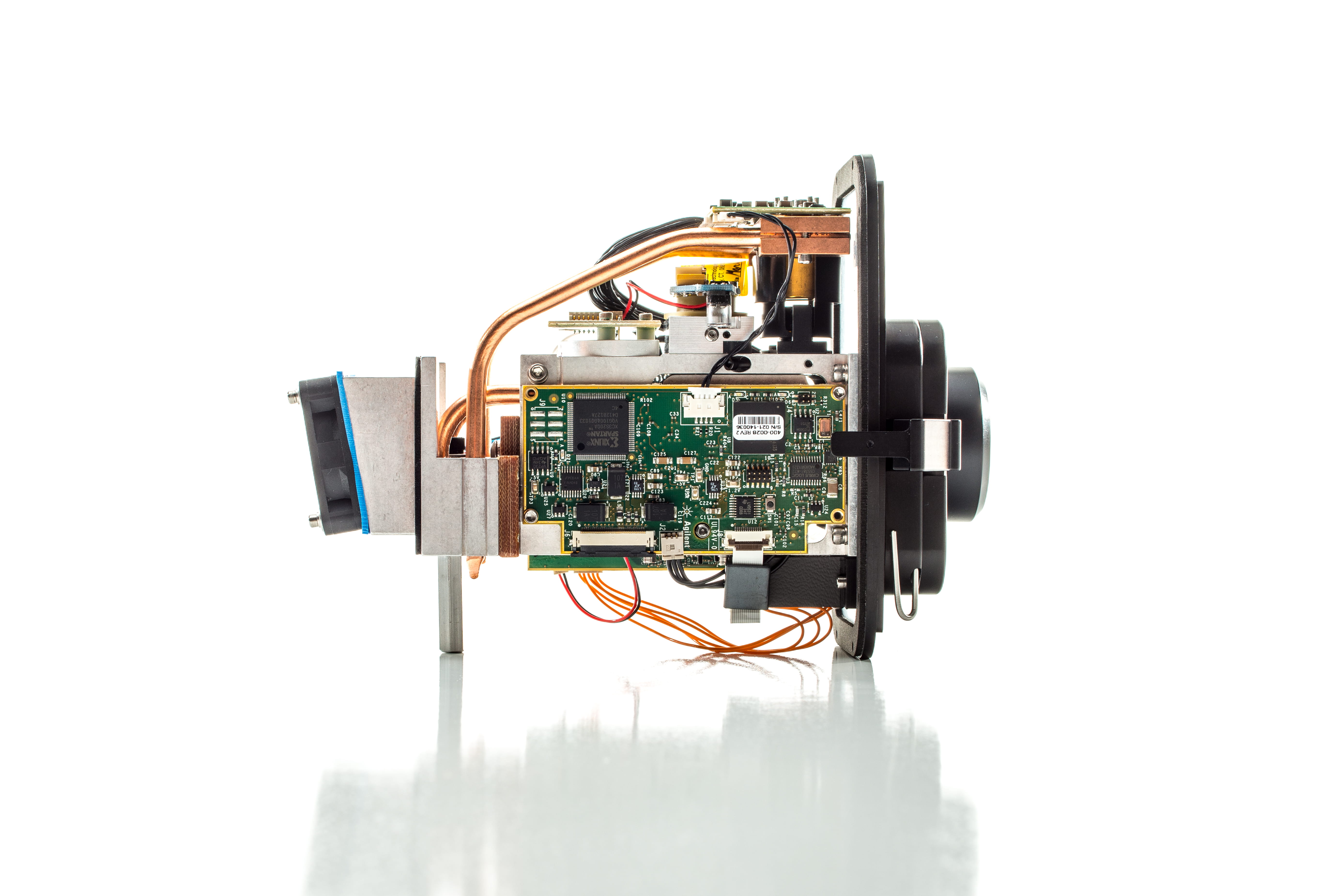
Presco delivered a complete FPGA and electronics package:
- A physics-based control loop, modeled as a mass-spring-damper system, implemented directly in FPGA fabric
- A dual-loop design pairing that physics model with a PID loop that only reacts to outside disturbances like hand jitter or bumps
- The instrument's full signal chain, FFT processing, noise reduction, and tilt compensation, also running on the FPGA
DNA Sequencer
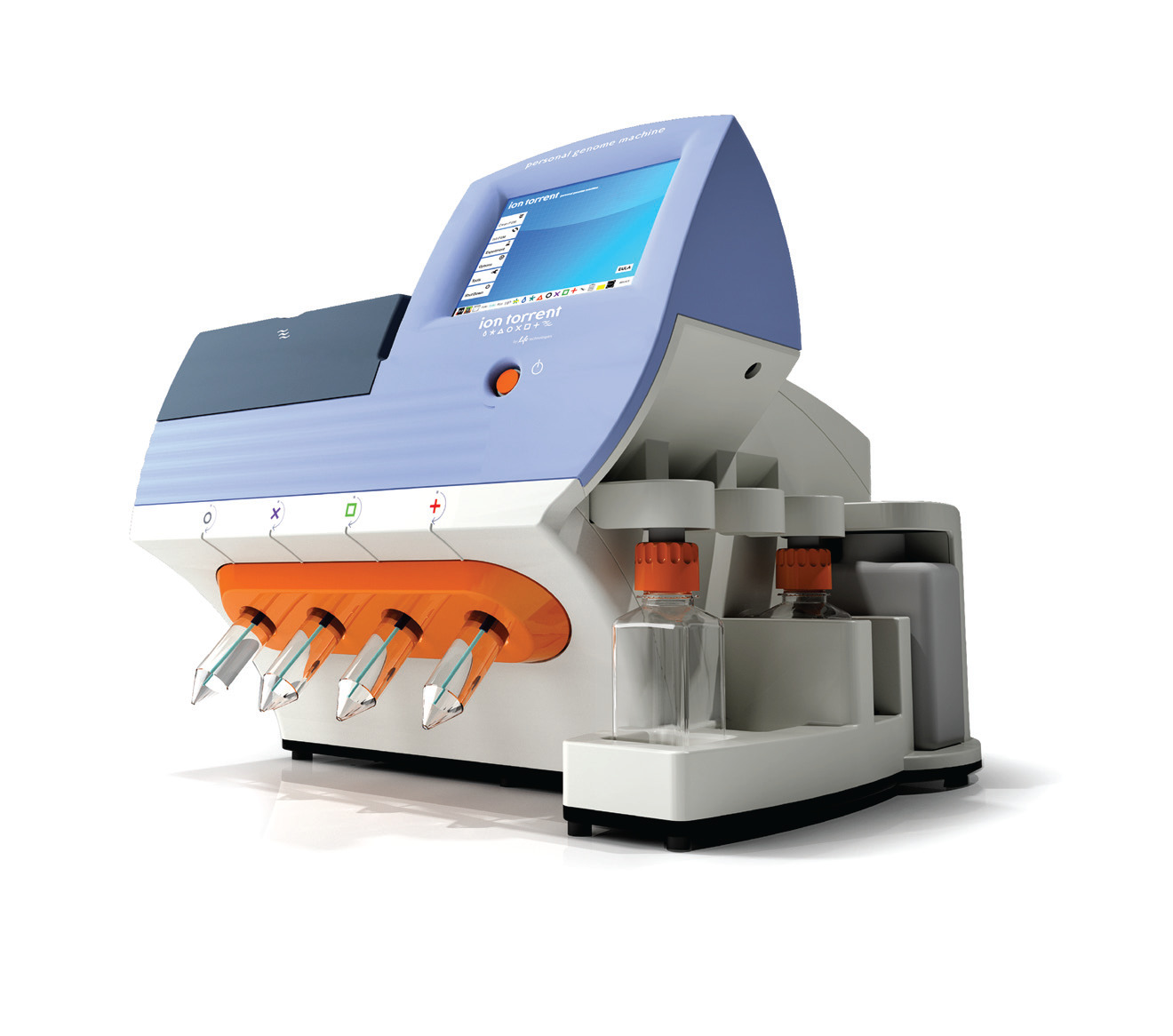
A client needed a life sciences instrument that could capture some of the faintest electrical signals in nature, the ion charges released during DNA sequencing chemistry, clean enough to read millions of parallel chemical reactions in real time, with a working prototype in four months.
The requirements left no margin:
- A noise floor sitting right at the theoretical physical limit for the signal
- A long observation window that stressed 1/f noise performance, not just ordinary thermal noise
- Aggregate sample rates equivalent to 1Gsps at 16-bit resolution, reading millions of parallel chemistry reactions off a single custom sensor chip
- A working prototype in about four months, to keep pace with an aggressive product timeline
Presco delivered a multi-stage FPGA architecture built for both performance and speed:
- Small FPGAs pulling data directly off the ADCs, handed over high-speed serial links to a central FPGA
- A custom lossless compression algorithm running in the central FPGA during each experiment's flush cycle
- An 18-layer board engineered to hit the timeline without giving up signal integrity

From Strategic Assessment to Production
Every custom FPGA design at Presco runs through the same five phases, whether you're handing us a full FPGA development program from scratch or bringing in surge support partway through, so nothing gets lost in a handoff.
Strategic Assessment
- Review the design early for architecture-level risk, timing, thermal, signal integrity, and how it needs to integrate into the larger system around it, before committing to an approach
- Scope requirements and architecture together upfront, so the design direction gets set once
Architecture
- System level architects collaborate with our electrical, mechanical, and software engineers to develop a comprehensive FPGA design
- Component and technology selection, validated against requirements
Development
- Detailed digital design in VHDL or Verilog, spanning everything from low-level bus infrastructure to complete signal chains running at multi-GSPS rates
- Control loops, signal processing, and data acquisition built directly in FPGA fabric: physics-based control models, high-speed ADC/DAC interfacing, FFT processing
- Every design exercised against Presco's proprietary testbench, simulated alongside models of every component on the board around it, with regression testing throughout development so late changes don't silently break something already validated
Qualification
- A sequence controller runs the complete test suite, covering every feature of the design, before it's signed off
- FPGA prototyping and validation on real hardware, proving the design against its requirements and the mil-spec, medical, or high-reliability standards it needs to meet
Production
- ISO 9001:2015 certified manufacturing, in the same facility as the engineers who designed the board
- Complete management of your product's lifecycle, from first production run through ongoing support
Sonitrol selected Presco as the designer of our Acoustic Recognition Engine, arguably the most advanced acoustic recognizer in the industrial world today. As a result of their work, we were able to reduce the false alarm rate by over 60%. I would not hesitate to recommend Presco for any complex task involving electronic design, software development or digital signal processing.
Talk Through Your FPGA Program
Tell us where your program stands, whether that's a design to build from scratch, surge support for a team already underway, or an intermittent problem that won't reproduce. We'll scope it with you.
Tel: 203.397.8722
FPGA Design Questions
What's included in Presco's FPGA design services?
Presco's FPGA design services cover the full lifecycle: architecture and requirements; digital design in VHDL, Verilog, and SystemVerilog; high-speed data acquisition and signal processing; control systems built directly in FPGA fabric; and prototyping and validation through our proprietary testbench methodology. Our FPGA systems engineers work directly alongside our electrical, mechanical, and software teams, so your FPGA is designed as part of the product, not handed off between vendors who've never spoken to each other. If you need engineering surge support for a program already underway instead of a full build, that's part of the same service.
How long does FPGA development typically take?
It depends on scope. A full FPGA design, from architecture through a working prototype, generally takes several months: one of our life sciences instrumentation clients went from design to a working prototype in about four months on an aggressive timeline. Root-cause diagnosis on an existing FPGA problem can move much faster: we found and fixed an intermittent field issue on a surgical device in under 10 days. Surge support engagements are scoped to whatever timeline your in-house team is already running on. The most accurate answer comes from a quick call, so we can scope the timeline against your specific requirements.
What does FPGA prototyping and validation involve?
Every FPGA design at Presco goes through our proprietary testbench methodology before it reaches you: the FPGA under test running alongside emulated versions of the real circuit board components around it, ADCs, DACs, DDR memory, SPI and I2C peripherals, rather than testing the FPGA in isolation. A sequence controller runs the full test suite and supports regression testing throughout development, so a change made late in a program doesn't silently break something already validated. It's a big part of why our FPGA designs hold up under mil-spec, medical, and other high-reliability requirements.
Do you handle NDAs and IP protection on FPGA design projects?
Yes. We routinely sign NDAs before discussing project details. Your IP and your data stay yours throughout the engagement.
Can Presco bring in FPGA engineering support mid-program, without taking over the whole design?
Yes. Surge support is one of the ways teams work with us: when your in-house team has the expertise but not the hands to hit a deadline, we plug in alongside them for a defined scope, bringing additional FPGA engineering capacity without the overhead of a full-time hire. You stay in control of the program; we take on the work that's creating the bottleneck.